
High Blood Pressure: Measure, Monitor and Modify

Categories
Drumroll please…In 2025, the publication of an updated Hypertension guideline was eagerly welcomed by health care providers across a wide range of medical specialties. This long-awaited collaboration of more than a dozen clinical organizations replaces the 2017 guidelines and addresses Prevention, Detection, Evaluation and Management of High Blood Pressure in Adults. The document reminds us about fundamental risks associated with hypertension, provides clarity about hypertension treatment goals and introduces a few new concepts.
First and foremost, hypertension affects heart and brain health. It is the most prevalent and modifiable risk factor for the development of cardiovascular disease. This umbrella term includes:
- Coronary heart disease: heart attacks, stents and bypass
- Heart failure
- Atrial fibrillation
- Stroke
- Dementia
- Chronic kidney disease
- All-cause mortality
Blood Pressure Basics
Blood pressure readings have two values. The top number is the systolic blood pressure (SBP) and the bottom number is the diastolic blood pressure (DBP).
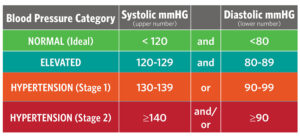
Data from a large survey of U.S. adults administered between 2017 to 2020 showed that overall, almost 50% of adults had blood pressure > 130/80 mmHg or were taking medications to treat high blood pressure. Although the diagnosis of hypertension is often associated with older age, it is common in younger age groups as well. I was surprised to read that in the 18-29 age group, 20% of men and 9% of women had hypertension.
Diagnosing Hypertension
Making the diagnosis of hypertension is not as easy as you may think. Multiple measurements of blood pressure are often required in the clinical office setting and at home. Furthermore, many factors impact accurate measurement of blood pressure including:
- Use of appropriate equipment: appropriately sized arm cuff
- Patient characteristics: no caffeine, exercise and smoking for 30 minutes before the measurement; no talking to office staff or scrolling on the phone
- Patient positioning: sitting, feet on the floor, back supported, arm supported at the level of the heart
- Measurement protocol: at least two measurements taken one minute a part on the same arm
Also, because a person’s blood pressure can vary, an office blood pressure measurement is ideally taken twice on two separate occasions during a clinic visit.
If a diagnosis of hypertension is suspected or treatment of hypertension is initiated, home monitoring of blood pressure is a valuable tool for your health care provider. When choosing a home blood pressure monitor, it is important that the device has been validated for accuracy (validatebp.org) and that the cuff size is appropriate for the size of the arm. Measuring your blood pressure with a cuff that is too small for your arm will often result in over-estimation of blood pressure and may lead to a false diagnosis of hypertension.
The American Heart Association website has excellent resources about home blood pressure monitoring including helpful video tutorials. Visit the Home Blood Pressure Monitoring web page.
Watch Cooper Clinic Exercise Physiologists Cristen Dicken and Ashton Gray share how to properly take an at-home blood pressure test.
Modifiable Risk Factors
Hypertension results from multiple factors including:
- Individual clinical risk factors such as overweight, obesity and obstructive sleep apnea
- Frequent use of medications such as decongestants or NSAIDs (nonsteroidal anti-inflammatory drugs)
- Genetic predisposition
- Health habits such as sedentary lifestyle or poor diet and chronic stress
Thus, a cornerstone of hypertension management is improvement in any modifiable risk factors for hypertension:
- Maintaining or achieving a healthy weight
- Following a heart healthy eating pattern by reducing sodium intake and increasing dietary potassium intake
- Adopting a moderate physical activity program
- Reducing or eliminating alcohol intake
- Managing stress
These updated guidelines add important information about the impact of stress on prevention and management of hypertension. Stress reduction through meditation, breathing control techniques or yoga may be reasonable to prevent or treat elevated blood pressure and hypertension, as an adjunct to changes in other health habits or medication treatment.
Medical Treatment of Hypertension
For all individuals with an average blood pressure ≥ 140/90 mmHg, in addition to making any necessary modifications detailed above, treatment with hypertension medication is recommended.
For high-risk individuals with a personal history of clinical cardiovascular disease, previous stroke, diabetes or chronic kidney disease, and an average blood pressure ≥ 130/80 mmHg, in addition to making any necessary modifications detailed above, treatment with hypertension medication is recommended.
For low-risk individuals (without a personal history of the high-risk conditions listed above) and an average blood pressure ≥ 130/80 mmHg, it is reasonable to focus on modifiable risk factors for hypertension for 3-6 months prior to initiating hypertension medication. The impact of changes in weight, diet and physical activity can add up and may eliminate the need for hypertension medication altogether:
- Consume a diet rich in fruits, vegetables, whole grains and low-fat dairy products
- Reduce content of saturated and total fat
- Reduce body weight by ≥ 5%
- Limit sodium intake to < 2,300 mg/day
- Engage in aerobic exercise for 90-150 minutes per week
- Engage in meditation or device guided breathing control to slow respiration
What many patients may not know is individuals who are diagnosed with hypertension and well treated on medication with average blood pressure levels <120/80 mmHg still have twice the risk for developing cardiovascular disease compared to individuals without hypertension who have average blood pressure levels <120/80 mmHg naturally. Thus, prevention of hypertension is critical!
To schedule a comprehensive preventive exam at Cooper Clinic, visit cooper-clinic.com or call 866.906.2667.
Article provided by Nina B. Radford, MD, FACC, Cardiologist at Cooper Clinic.