
Better Balance At Any Age
Categories
Remember PE class in school? We enjoyed running around the gym or playground with friends, playing hopscotch or doing crab walks. What we may not have realized is that we were working on our balance. Yet as we age, our balance wavers, just as our activity fluctuates. Moving on from PE classes to team sports to elite running or fitness classes, our bodies need stability to perform at their best. Cooper Fitness Center Professional Fitness Trainer Paul Mossa explores the relationship between balance and coordination and the key to improving daily movements with strength training.
Balance and Coordination Go Hand-in-hand
Balance is the foundation to moving well. Poor balance results in slower everyday movements and can make simple activities such as sitting, standing and picking up a gallon of milk more difficult. “You need both balance and coordination together to move well,” says Mossa. Good coordination improves reaction time and helps you move more quickly, which typically declines with age.
“I work with a lot of clients who say they have poor balance and cannot move as quickly as they used to,” says Mossa. As we age, our joints and muscles become weaker, making our circle of stability smaller. Your circle of stability is determined by how far and how easily you are able to move away from your center of gravity. Incorporating balance- and coordination-specific exercises into your exercise routine will help increase your circle of stability, strengthening your joints and muscles and improving your daily movements. Additionally, improved balance and coordination prevent injuries and falls, improve fine motor skills and increase your overall range of motion. Mossa recommends practicing and testing your balance at least three times a week, if not daily to build strength and reduce your risk of falls and injury.
Functional Exercises
In addition to balance and coordination, functional exercises can also help you train for your everyday life. “While everybody’s life is different, some common exercises target the movements people do every day,” says Mossa. These exercises help you perform your daily activities and can build muscle and improve mobility, balance and stability. Mossa explains, “balance and function are closely related. Daily activities, or functional movements, require good balance.”
Examples of functional exercises:
- Carrying: Any kind of loaded carry with one or two arms
- Squatting: Any type of squat with body weight, dumbbells, cables or barbells
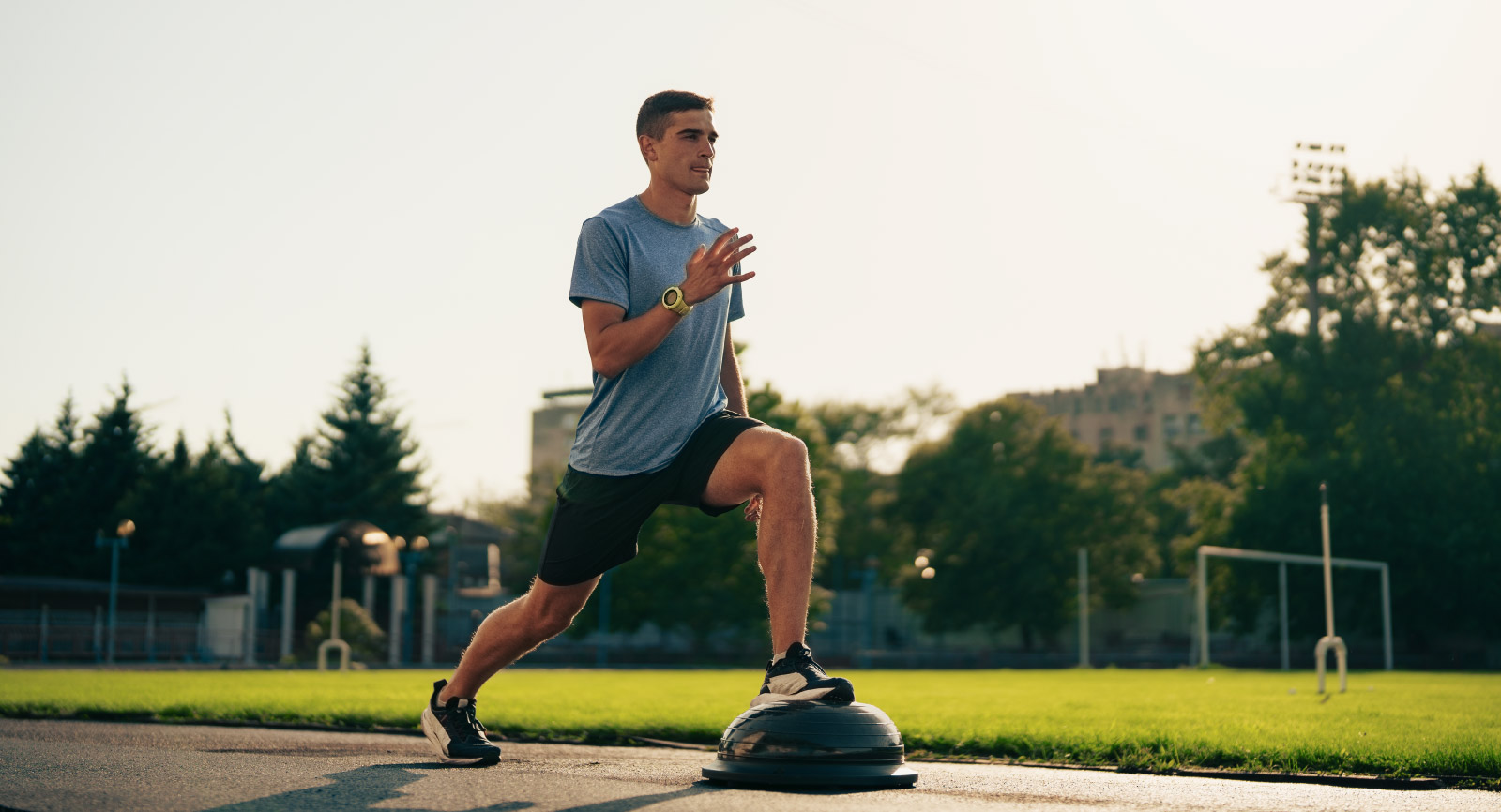
- Single leg: lunges, balance, step-ups and side lunges
- Hip hinge: Romanian deadlifts or single-leg Romanian deadlifts
- Pushing: push-ups, bench press, shoulder press and cable press
- Pulling: pull-ups, cable rows, dumbbell rows and body rows
Test Your Balance
Testing your balance can help pinpoint weak points you may have in your muscles and determine what you need to work on. Test your balance with one of the following movements.
- Single-leg Balance: With feet placed shoulder width apart, slowly raise one of your knees to 90 degrees. Try to stand with your chest upright without wobbling or moving around. Repeat with the opposite leg.
- Tight Rope Balance: Place one foot in front of the other, like you are on a tight rope. Try to stand still with your chest upright. Take it a step further by lifting your back heel off the ground.
If you can perform the above movements without losing your balance or moving around, you have good balance. You can progress the movements and make them more difficult by closing your eyes. “Closing your eyes has to do with spatial awareness,” says Mossa. “Spatial awareness is knowing where your body is in relation to your environment, so testing your balance with your eyes both open and closed can tell you if you need to work on this.” Even if you can perform the above movements easily, it is still important to incorporate balance training exercises—such as strength training—into your weekly routine.
For a demonstration of balance exercises, watch the following Exercise Moves videos:
Your Core Is Key
Many people believe improving balance comes from practicing standing on one foot. While this kind of movement can help test balance, building lower body strength through your ankles, knees, hips and core builds better balance.
“Strength training is a great way to improve your balance,” says Mossa. “Incorporating exercises that target your lower body and all planes of motion (forward and backward, left to right and up and down) increases stability and creates smoother, quicker movements.” A result of aging is becoming slower in our movements which can be seen through dragging your feet and not being able to move as far or as fast as you used to. Building muscle strength can help combat this.
Mossa says, “Exercises such as squats, leg press and lunges are great for building lower body strength. You can target all planes of motion by changing the direction of the exercise such as lunging forward and backward. If the movements are too difficult at first, you can modify them by holding onto a wall or chair while performing the exercises.”
A Boost in Brain Health
Improving your coordination and proprioception—being aware of where your body is in space and being able to control it—also helps with balance. The agility ladder is a great way to increase reaction time, coordination and proprioception. Improving coordination also increases your brain health by promoting fine motor skills. Your fine motor skills are essential in helping you move smoothly, respond to things quickly and know which part of your body to move when.
Test and practice your balance regularly. Mossa says, “As we age, it gets harder to move but if you regularly incorporate strength training into your exercise routine and work toward better balance and coordination, you’ll be able to move more and move better and longer.”
For more information on personal training at Cooper Fitness Center or to schedule a session with a professional fitness trainer, visit cooperfitnesscenter.com or call 972.233.4832.